The recent death of Mandela has affected me more than I expected, and from talking to others, this is a shared experience.
While I am obviously sad at the death of an amazing human being, it's made me think a lot about my place in South Africa. I have always dismissed the idea of any other country becoming my home, and feel out of place in other countries. Unfortunately that hasn't led me to feel at home in South Africa. At times I feel like a foreigner here, but at the same time, like I have something that falls in between a duty and a desire to be here. This feeling has led me to not live fully in place during my time overseas, and contributed to the ending of one of my most significant relationships.
I am not entirely sure what this has to with Mandela's death, all I know is, as I lay in bed crying at the news, I was crying for myself as much as for the event. Mandela represented an ability to get the work done that needs to be done in South Africa (and of course the world). That he should die at a time when there is still so much to be done, and no clear leaders to continue his work contributed to my unsettled feelings over the last days.
It feels like we have lost one of our most inspiring, strong and good allies. It makes me realise how much there is to do, and worry about my own ability to do the work that is needed. In South Africa, it makes me realise how much easier life can be in other countries, where I am not faced by my privilege and otherness (real or perceived) everyday, and don't wrestle with my place in the world as strongly. It brings in to focus the fact that my place in the world will not easily allow me to feel at peace wherever I am.
I have linked my own life so strongly with the work for environmental justice, and as a result have inextricably linked the narratives of the struggle for environmental justice and the struggle for freedom from Apartheid. How can I question whether my parents did enough to bring down Apartheid ideology, when I live a life that so clearly shores up and contributes to the environmentally destructive day to day routine of civilisation?
So while the news channels run 24/7 coverage of the unfolding of the death of a great man, I sit with a lap full of questions and unease. I am interested to see where both lead my country and myself.
Sunday, December 08, 2013


Saturday, July 27, 2013
Another corporate smut fest
I'm doing the Walk the Talk tomorrow. It's a variety of lengths (I'm doing the 8km walk with Spencer, my dog) and proceeds go towards a community project - last year they built a bridge out of recycled plastic over a swampy part of Emmarentia Park.
I went down to get my race number and was not too surprisingly disgusted by the corporate detritus coating anything solid. One could be forgiven for thinking the event is not much more than getting together a crowd of people (consumers) and advertising at them for half a day. I guess we have to get out from behind our TVs at sometime, and heaven forbid we should actually do something that doesn't in some way contribute to the take make waste system.
This tendency for companies to think they have the right to invade every aspect of our life with their whinging pleas for us to buy things we don't need seems to be growing. Like a cancer. And increasingly we think that doing something good must start with getting "benevolent" companies on board to bank roll the event. If we stopped supporting these companies in any way, many of the problems these sorts of events aim to address would fade. End the corporate welfare system, and support people and planet directly.
I'm still looking forward to walking 8km tomorrow with Spencer and the broader Joburg community. I will try and keep the real reason for being there in the front of my mind.
Disclosure: I have health insurance with Discovery, the headline sponsor (read: most guilty) of Walk the Talk. I would love to start a crowd funded health insurance fund for myself and my community. Next project.
I went down to get my race number and was not too surprisingly disgusted by the corporate detritus coating anything solid. One could be forgiven for thinking the event is not much more than getting together a crowd of people (consumers) and advertising at them for half a day. I guess we have to get out from behind our TVs at sometime, and heaven forbid we should actually do something that doesn't in some way contribute to the take make waste system.
This tendency for companies to think they have the right to invade every aspect of our life with their whinging pleas for us to buy things we don't need seems to be growing. Like a cancer. And increasingly we think that doing something good must start with getting "benevolent" companies on board to bank roll the event. If we stopped supporting these companies in any way, many of the problems these sorts of events aim to address would fade. End the corporate welfare system, and support people and planet directly.
I'm still looking forward to walking 8km tomorrow with Spencer and the broader Joburg community. I will try and keep the real reason for being there in the front of my mind.
Disclosure: I have health insurance with Discovery, the headline sponsor (read: most guilty) of Walk the Talk. I would love to start a crowd funded health insurance fund for myself and my community. Next project.
Monday, April 08, 2013
Nuclear's death gasps
I'm getting pretty tired of hearing the nuclear argument. A friend recently sent me the same old argument. It's here, below my reply:
As a footnote to it. The author ends on an interesting note - that we need to choose our poison when it comes to energy. I think that is a good point. There is another option however. Don't use electricity. My choice.
Oh man so old.
Pathetic really.
--
As a footnote to it. The author ends on an interesting note - that we need to choose our poison when it comes to energy. I think that is a good point. There is another option however. Don't use electricity. My choice.
Oh man so old.
- Most people who are against atomic power want renewables, not gas or coal.
- We don't want anyone to die. Not less people to die.
- Financially, nuclear is MUCH more expensive, if you take into account waste and decommissioning and insurance. I say if here, but there isn't really an "if" when it comes to the costs. The only if is whether it is taken into account or not.
Pathetic really.
On 8 April 2013 09:31, A Friend wrote:
Just saying …Feed: Co.Exist
Posted on: 05 April 2013 04:01 PM
Author: Ben Schiller
Subject: Forget Fukushima, Nuclear Power Has Saved 1.8 Million Lives
But exactly how dangerous is nuclear really? It depends on how you look at it. In absolute terms, nuclear is as risky as hell. We would never conceive of building something like a nuke station, if we didn’t have to. But comparatively speaking? That’s perhaps another story.
From 1971 to 2008, 4,900 people died as a result of nuclear power.A new paper by two researchers at NASA’s Goddard Institute of Space Studies calculates the damage if we hadn’t had nuclear power for the last several decades, and what damage might be caused if we don’t embrace the technology going forward.
Pushker Kharecha and James Hansen estimate that 4,900 people died as a result of nuclear power between 1971 and 2009, mostly from workplace accidents and radiation fallout, but, they said, 370 times more people (1.84 million) would have died, had we generated the same power from fossil fuels.
The scientists’ figures are based on estimates of mortality caused by particulate pollution, which killed 1.2 million people in China in 2010, according to a recent report. And it gets worse. They say burning natural gas to replace nuclear power will result in at least 420,000 deaths by 2050, and 7 million more if we replace it solely with coal.
Burning natural gas to replace nuclear power will result in at least 420,000 deaths by 2050.Aside from immediate health impacts, Kharecha and Hansen’s point is to show that we really can’t do without nuclear if we want to keep climate change within manageable boundaries. They believe that renewables won’t supply the scale or dependability to replace nuclear, if we want to stay under a 1 degree C global temperature rise (above preindustrial levels). "Achieving these targets emphasizes the importance of retaining and expanding nuclear power, as well as carbon-free renewables, in the near-term global energy supply," they say.
The paper says nuclear power prevented 64 gigatonnes of CO2-equivalent greenhouse gas emissions in the period to 2009 and would prevent 80 to 240 gigatonnes by 2050, depending on the replacement.
Kharecha and Hansen’s paper is likely to annoy (perhaps too mild a word) opponents of nuclear power who tend to exaggerate the actual evidence of harm. The best science shows that the long-term fallout from major nuclear accidents has been more modest than advertised. The paper states:
..no deaths have been conclusively attributed (in a scientifically valid manner) to radiation from the other two major accidents, i.e. Three Mile Island in March 1979, for which a 20-year comprehensive scientific health assessment was done, and the March 2011 Fukushima Daiichi accident.Meanwhile, a United Nations study of the 1986 Chernobyl accident, the worst in history, found that 43 people died, including 15 first responders.
Kharecha and Hansen’s point is not to minimize these deaths, or nuclear’s larger risks or costs, but to put them in comparative context. Rail against nuclear, if you want to. But when it comes to energy, you have to choose your poison.


--
Love, Respect, Action.
Wednesday, March 20, 2013
Why insurance companies are bad
They work against community. If you know anything about me, you'll know that that would be a sure-fire way to piss me off. Building, supporting and nurturing community is one of, if not the, most important way we can make the world a better place.
Insurance companies start out badly on this account. The whole premise behind them is that we should not trust or rely on each other, but should rather buy security and peace of mind. So instead of looking out for each other and resolving our problems together, we rely on someone who we've never met before on the end of a phone, and internet banking.
I found an even better example of their assault on social cohesion yesterday. Apparently they won't insure household contents if more than 2 people live in your house who are not family relations. Way to breed a little mistrust and resentment assholes.
I hope they don't mind that I see everyone as my brothers and sisters. Now just to decide whether I want to get rid of all my stuff, or start my own community based insurance scheme - anyone in?
Insurance companies start out badly on this account. The whole premise behind them is that we should not trust or rely on each other, but should rather buy security and peace of mind. So instead of looking out for each other and resolving our problems together, we rely on someone who we've never met before on the end of a phone, and internet banking.
I found an even better example of their assault on social cohesion yesterday. Apparently they won't insure household contents if more than 2 people live in your house who are not family relations. Way to breed a little mistrust and resentment assholes.
I hope they don't mind that I see everyone as my brothers and sisters. Now just to decide whether I want to get rid of all my stuff, or start my own community based insurance scheme - anyone in?
Thursday, January 10, 2013
Eating jobs
Walmart recently entered SA to much fanfare and consternation. Capitalists licked their jowls and trade unionists protested. Some people celebrated cheap prices and wider range, while some worried about their jobs.
What can you do about this? Unless you're an activist, and it's your life's work, not much. Perhaps you could hit capitalism where it hurts though. Never enter a Builders shop (there are a bunch of different types) without a shopping list, and never leave with more than is on your shopping list. What do you think?
---
I caught a glimpse of what Walmarts entry into SA might mean yesterday. On the way to the station, we drove past the Timbercity in Lakeside. Timbercity is a South African hardware chain store. A few years ago a Builders Wharehouse (a Walmart subsidiary) opened up about a kilometre and a half up the road. The writing was on the wall for Timbercity and all the people who worked there. My phone automatically capitalises Walmart, it doesn't recognise Timbercity. Builders Wharehouse has the support of Walmart and all that comes with. They can stay open late and on weekends and not worry about initial loses, they have a much bigger range than Timbercity and they will soon be a monopoly. Already my friends in Joburg talk about going to Builders and not the hardware store. I don't think this consolidation of the market place is good for society. The invisible hand of the market will ensure there are less jobs and the jobs there are are McJobs (compare the concept of a job to a livelihood).
To put a human face on all this. I was walking my dog on Zandvlei, near where I lived at the time. The dog ran into the vlei near the bridge and went after a duckling. A man saw it happen, and didn't see the duckling reappear. He told me that he thought my dog had killed it. Not in an angry way, more just sad. I saw he had a Timbercity shirt on, and recognised him from there.
He walked off, I scolded my dog and stood looking out over the vlei in the direction of the beach and water slides where the duckling had been. Pretty soon I saw the duckling bob back to the surface and join its (my long range duckling sexing skills aren't what they used to be) parents. I was happy.
I had to go into Timbercity later that day and saw the same guy. I told him the duckling had survived - he was really happy. I hope he has managed to find a job somewhere else now.
Wednesday, January 09, 2013
Hope
It started with a conversation about a platform shop. As we pulled out of Cape Town Station he said it would be great if we could just quickly buy something from the shop, if only they had an entrance on the platform. Sweets, something to drink or a newspaper. Then they would make a killing. I said "but then the people would get free access to the train, and they'd have to control it". Silence. Me problem solving: "What about a small window. Then people could just say what they wanted, pay for it and it gets passed through the window." Satisfied silence?
 As we approach De Doorns, we stop and wait for police to clear striking farm workers off the tracks. The police on board ask us to close the blinds in case people are throwing stones. For a moment, me and my camera phone feel like a member of the Bang Bang Club. Somehow sharing a tense moment gets the conversation going again. He tells me about a farmer he met who sends grapes from that area all over the world. He is angry at others eating grapes when South Africans can't. I am too.
The dry Karoo landscape silences mirror our conversation like the distant mountains. A political mountain approaches. We talk with disgust of Jacob Zuma and Nkandla. He tells me about meeting Ramaphosa "...before NUM. Before he changed his jacket. When he used to run side by side with Biko". I'm fleshing out my academic history with these gems, scattered like the sheep across the landscape. We both agree that education is the key. He tells me how he would put money into teacher training colleges if he were Zille and uplifting schools like Langa High to be more like Rondebosch Boys Prep. Langa High was the only high school for Africans in Cape Town when he was young. My dad went to "Roast Beef and Pork Sausages".
Train and electricity warning signs alert non-existent drivers that they will soon cross our path on the dusty roads. I tell him I want to mentor young people and how I think that that is so important. I don't mention her, but I'm proud of my mums work when he agrees with me that it is important in overcrowded schools. He tells me he worked for the Western Cape Government. I'm proud to explain my work, but tell it from the peoples side, not the environments. He is a proud PAC supporter. Robert Sobukwe said there is only one race, the human race, as we cross a river. The PACs downfall was accepting money from a white Australian woman. It shouldn't have been. He's angry because of that. Mandela didn't have a mandate from the ANC or the people of South Africa to negotiate. Mandela sold us out, and he's not too impressed with the little man, Tutu, either.
He didn't start talking about the grape farmer once we had passed the striking workers. What he told me was that when he went to school in Fort Beaufort (because there was only one high school in Langa for Africans) he used to hate taking the train. He said that with passion, and his bottom lip quivered. There used to be a shop on the platform, and only the white people could go inside. The black people were served through a small window on the side.
As the Karoo succumbs to sunset he says "I'm glad I could speak to you, Glen." I say, "I am too, Sky." I think how glad I am there wasn't a free coupe. He goes to get water to take his pills.
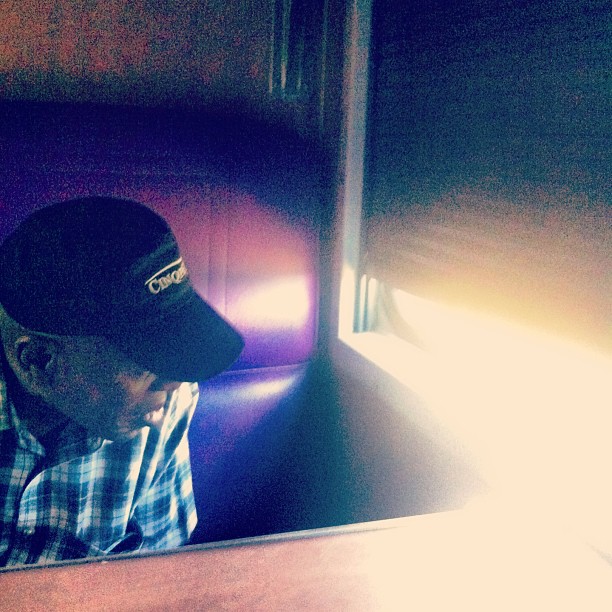 As we approach De Doorns, we stop and wait for police to clear striking farm workers off the tracks. The police on board ask us to close the blinds in case people are throwing stones. For a moment, me and my camera phone feel like a member of the Bang Bang Club. Somehow sharing a tense moment gets the conversation going again. He tells me about a farmer he met who sends grapes from that area all over the world. He is angry at others eating grapes when South Africans can't. I am too.
The dry Karoo landscape silences mirror our conversation like the distant mountains. A political mountain approaches. We talk with disgust of Jacob Zuma and Nkandla. He tells me about meeting Ramaphosa "...before NUM. Before he changed his jacket. When he used to run side by side with Biko". I'm fleshing out my academic history with these gems, scattered like the sheep across the landscape. We both agree that education is the key. He tells me how he would put money into teacher training colleges if he were Zille and uplifting schools like Langa High to be more like Rondebosch Boys Prep. Langa High was the only high school for Africans in Cape Town when he was young. My dad went to "Roast Beef and Pork Sausages".
Train and electricity warning signs alert non-existent drivers that they will soon cross our path on the dusty roads. I tell him I want to mentor young people and how I think that that is so important. I don't mention her, but I'm proud of my mums work when he agrees with me that it is important in overcrowded schools. He tells me he worked for the Western Cape Government. I'm proud to explain my work, but tell it from the peoples side, not the environments. He is a proud PAC supporter. Robert Sobukwe said there is only one race, the human race, as we cross a river. The PACs downfall was accepting money from a white Australian woman. It shouldn't have been. He's angry because of that. Mandela didn't have a mandate from the ANC or the people of South Africa to negotiate. Mandela sold us out, and he's not too impressed with the little man, Tutu, either.
He didn't start talking about the grape farmer once we had passed the striking workers. What he told me was that when he went to school in Fort Beaufort (because there was only one high school in Langa for Africans) he used to hate taking the train. He said that with passion, and his bottom lip quivered. There used to be a shop on the platform, and only the white people could go inside. The black people were served through a small window on the side.
As the Karoo succumbs to sunset he says "I'm glad I could speak to you, Glen." I say, "I am too, Sky." I think how glad I am there wasn't a free coupe. He goes to get water to take his pills.
Sunday, December 30, 2012
Dogs
Zuma's has gone too far. I mean the whole rape trial, arms deal corruption and the hollowing out of our democracy was bad and so I guess this was just the final straw. He said that owning dogs and looking after them (taking them to the vet and for walks) is part of "white culture" - whatever that is. He also said that people who spend more money on their dogs than their domestic workers "lack humanity".
I reacted to JZs utterances emotionally, because I own a dog. However I really think that there is far more going on behind what he is saying that warrants outcry, whether you are a dog owner or not. We should want change, we should want to discuss these things and we should want more social stability and equality. Trying to approach these questions through the off hand comments of a career politician who is in it for the cash is not the way to go about it.
There is a lot in this and it's got me thinking - which I guess is one positive. Being a dog owner, I reacted very strongly when I heard what JZ had said. The first bit - about white culture - I don't think much can be said about in terms of arguing the point. I don't know what white culture is, but referring to it is an example of JZs leadership style. Well, calling it leadership is a bit too generous. His career or survival skills. It is so very divisive. Playing groups off against each other to win votes - I think Not what I'd expect from the leader of a democracy.
On to the "lacking humanity" bit. This gets a bit trickier. Comparing an employee who cleans your house or tends your garden to a dog is not easy. One is an employee and the other a dependant, and to suggest they are both dependant would, I would think, be insulting. So to simply look at your budget and say I spend R1000 on my dog every month (I actually spend about half that) and R500 on having my house cleaned (I actually pay R200 for one day a week at the moment, but would prefer not to have any domestic help - more on that later) and therefore I value my dog twice as much as the person who cleans my house, is very problematic.
This is not to say that some people's monthly budgets aren't seriously out of whack, or that people don't pay the people who clean their houses or tend their gardens enough. It also doesn't mean that JZ can not talk about that or actually DO something about it (shock horror). If he really has a problem with dogs, how about making dog food more expensive? Or even better taking on the WTO and raising huge import tariffs on imported dog food? After all most of the brands of expensive dog food are imported from the US or EU - now that is crazy!
Going beyond dogs, and if humanity was something JZ really wants to get serious about, how about getting a task team or the National Planning Commission to look into some standards that everyone in SA could live sustainably by and then encourage people to live according to these (whether that would allow people to own dogs or not, I don't know). That might mean JZ would have to live according to those standards too though - something he seems incapable of doing, rather setting the worst example of fiscal responsibility for the rest of the nation.
JZ using these sorts of issues as a way to entrench his grip on power sickens me.
Wednesday, December 12, 2012
What did I think of Tanzania?
 Let me tell you. It was hot. I'm talking 31 degrees on my way to the airport at 4am this morning hot. Most of my clothes are still sweaty, and I'm wondering if my Earthsap washing powder is up to the job. One thing I lost is my concern for walking into a meeting with sweat patches on my clothes. To hot to care. Often I couldn't get more than those four words through he fug of my brain.
 Not that this was a bad thing. I wallowed in the heat at times - especially when I could. That was normally just before getting to another wave of air conditioning or the Sunday morning I had on Kipepeo (butterfly) beach. The city itself is really friendly with everyone willing to go out of their way for you. From the guy at breakfast who always looked like he was super happy to see me, to Taxi drivers telling me about "their" Dar.
 That is probably one I the best memories of my trip - I managed to use every form of public transport there was, except cycling. I took taxis, a couple of Dala dalas, piki pikis a bus, bajaj and of course walked quite a bit. The dala dalas are very similar to minibus taxis in SA, just bigger and cheaper. Crazy cheap. R1.50 for pretty much any ride. The piki pikis are motorbike riders who'll take you where you want to go in the bliss of the open air. Bajaj are tuk tuks in various states of repair.
 The other great thing was the fruit - everywhere, big and sweet. On the trip to Morogoro to speak to some professors of agriculture, there were mangoes dripping off the trees, and when I got to taste them, they were goooood. I also bought a big pineapple and some Jamul - a new fruit for me. I could have racked up way more than one new fruit - if only I'd had a kitchen a fridge that didn't freeze everything that went near it. That said, I had THE best banana and pineapple ice cream ever. Oh the bananas - so good, they have that tang you only really get in bananas grown not for supermarket - almost like they have a hint of guava. Guess this is one of the reasons I do what I do.
 The work itself was great - nice and flexible and without too much pressure. Getting to know the country and the issues around agriculture here. It's a place where 80% of farmers are small holders (about an acre or less) and 98% of the ag is rainfed. It's also a place were stunting is rife - in 42% of children under 5. Scary stuff. Especially when most of the big ag initiatives are pushing production of commodities and monoculture a of the staples, maize, rice, sorghum, etc. I think the solution to this "hidden hunger" is a diverse diet. Your mom was right when she told you to eat your greens.
There is a lot to do, and the sector has the feeling of a good rush, with land grabbers and big agri-business rushing to get a piece of the pie, which is often already on someone else's plate. There is a big job ahead, to tell the story of a different model of agriculture, one that is farmer centric and knowledge intensive as opposed to merely technology intensive. I've got a much better idea of the challenges ahead now, and I've also learnt, that if I can learn to love the heat, Tz is a country I would love to come back to.
Sunday, December 02, 2012
Plastic rhino horns
I think wanting to help the rhino avoid extinction is a very noble cause. In exactly the same way as I think wanting to help the Ethiopian wolf (<500 left) Sumatran tiger (<400 left) Cape Leopard toad, African wild dog and every other threatened species is a very good idea.
What is the primary reason for most of these species threatened status? Habitat destruction. And by habitat, I mean the web of life and ecosystems they and all species depend on, not just the geographic area the species inhabit. Oh, and incidentally I include humans in that "all species". The dominant way of life of most of humanity is destroying that habitat - in short, civilisation. The idea that the soon-to-be-majority of us can live completely disconnected from our land base and off the work (and what corporate environmentalists like to call "eco-system services") of others.
Of course poaching plays a part, but this is a part of the cause, not the cause itself. Let's be clear - our use of electricity and the pollution and very real habitat destruction it causes is MUCH more of a threat than poaching. That is just one example. Our increasing reliance on plastic is another. Look at the pacific garbage patch and the amount of sea birds (and countless fish that are never found) that it kills.
So while I love the idea that many people are concerned for the fate of the rhino, strapping a purpose built plastic rhino horn to their car (and in many cases their 4x4) is part of the problem. It is however indicative of our separation from nature. We are so far divorced from that which we love and which we rely on that we are killing it to try and save it.
I know I know, there is no pleasing some people.
Cut plastic out of your life. Reconnect with your land base. Reconnect with your community. Those are some places to start.
What is the primary reason for most of these species threatened status? Habitat destruction. And by habitat, I mean the web of life and ecosystems they and all species depend on, not just the geographic area the species inhabit. Oh, and incidentally I include humans in that "all species". The dominant way of life of most of humanity is destroying that habitat - in short, civilisation. The idea that the soon-to-be-majority of us can live completely disconnected from our land base and off the work (and what corporate environmentalists like to call "eco-system services") of others.
Of course poaching plays a part, but this is a part of the cause, not the cause itself. Let's be clear - our use of electricity and the pollution and very real habitat destruction it causes is MUCH more of a threat than poaching. That is just one example. Our increasing reliance on plastic is another. Look at the pacific garbage patch and the amount of sea birds (and countless fish that are never found) that it kills.
So while I love the idea that many people are concerned for the fate of the rhino, strapping a purpose built plastic rhino horn to their car (and in many cases their 4x4) is part of the problem. It is however indicative of our separation from nature. We are so far divorced from that which we love and which we rely on that we are killing it to try and save it.
I know I know, there is no pleasing some people.
Cut plastic out of your life. Reconnect with your land base. Reconnect with your community. Those are some places to start.
Thursday, November 29, 2012
Why I mac
This is something I feel I need to explain. I own an Apple Mac laptop. Not only that, I also own an iPhone, I bought both of those, and I was given an iPod. That's quite a bit of Apple.
I often want to explain having those gadgets - after all, they are much more expensive than other tech gadgets that do essentially the same job. Yes, Apple products are nice and in some ways easier to use, but they still crash, they still have problems running some programs - they are still computers, made by humans, not perfect. So why would I buy an expensive computer or phone?
Well, first reason was environmental, and if you've been reading this blog for a while, you'll know environmental issues are often the first thing I consider. Apple was a target of a Greenpeace campaign I worked on, and together with my amazing colleagues, won. Apple committed to remove all the PVC and BFRs (Brominated Flame Retardents - nasty chemicals that do all sorts of bad things including messing with our hormones) from their products. It started with one - the MacBook Pro I'm currently working on (that aluminium body isn't just for looks), and now most if not all of Apples products are PVC and BFR free.
The second reason is also environmental - I hope as it was one of the fastest laptops it will last longer than the normal 3 years laptops are supposed to last. It also has a better battery life than most of the laptops I have had or my friends have - another reason I won't have to buy another laptop soon. Yes, the battery cannot be removed, but I haven't had to yet, and if I do, my argument will fall down, but speaking of that...
Another reason I've heard that people don't like Apple is that their products tie you into their "eco-system". I'm purposefully trying to avoid that by using other companies products such as a Kindle and a PC at work. Let's not lie though, every company is trying to tie you in -I'm probably more tied into Google than Apple. Google owns most of my data, even this blog is written on a oogle platform.
So, no I don't think Apple is the most amazing company in the world. If I could really follow my ideals, I would not buy a computer at all - I think they separate us from the natural world. I have chosen a life that requires these tools though, and as such I will make the most environmentally sound decisions I can, in full knowledge that buying any product mined from the earth and whose production pollutes the earth is not sustainable.
I often want to explain having those gadgets - after all, they are much more expensive than other tech gadgets that do essentially the same job. Yes, Apple products are nice and in some ways easier to use, but they still crash, they still have problems running some programs - they are still computers, made by humans, not perfect. So why would I buy an expensive computer or phone?
Well, first reason was environmental, and if you've been reading this blog for a while, you'll know environmental issues are often the first thing I consider. Apple was a target of a Greenpeace campaign I worked on, and together with my amazing colleagues, won. Apple committed to remove all the PVC and BFRs (Brominated Flame Retardents - nasty chemicals that do all sorts of bad things including messing with our hormones) from their products. It started with one - the MacBook Pro I'm currently working on (that aluminium body isn't just for looks), and now most if not all of Apples products are PVC and BFR free.
The second reason is also environmental - I hope as it was one of the fastest laptops it will last longer than the normal 3 years laptops are supposed to last. It also has a better battery life than most of the laptops I have had or my friends have - another reason I won't have to buy another laptop soon. Yes, the battery cannot be removed, but I haven't had to yet, and if I do, my argument will fall down, but speaking of that...
Another reason I've heard that people don't like Apple is that their products tie you into their "eco-system". I'm purposefully trying to avoid that by using other companies products such as a Kindle and a PC at work. Let's not lie though, every company is trying to tie you in -I'm probably more tied into Google than Apple. Google owns most of my data, even this blog is written on a oogle platform.
So, no I don't think Apple is the most amazing company in the world. If I could really follow my ideals, I would not buy a computer at all - I think they separate us from the natural world. I have chosen a life that requires these tools though, and as such I will make the most environmentally sound decisions I can, in full knowledge that buying any product mined from the earth and whose production pollutes the earth is not sustainable.
Tuesday, April 17, 2012
Patrolling the hood
It's another dark, and this time rather stormy, night. 20:05 and I pull myself off the comfortable couch and get on my walking shoes and some warm clothes - it's patrol time. I meet up with 3 other volunteers from my community and together we brave the wind, walking around our neighbourhood for an hour.
Every Tuesday I patrol Muizenberg with friends from the Muizenberg Community Safety Initiative. There are usually 4 of us guys, and sometimes Jane joins us. We all wear hi-vis vests with the MCSI logo on them, and one of us carries a radio - our only defense against the night. Our job is to patrol the neighbourhood, and to report any suspicious activity. It is a passive patrol and we will never engage with "trouble", but rather call it in to the local security company, who can in turn call the police. So far we've only uncovered one daring raid on the metal of the railway tracks for scrap. Or so we thought. Turned out is was just a late night gang repairing the railway line.
We only patrol for an hour, but similar patrols go out every other weekday, and we take random routes. Perhaps not stopping crime, but hopefully making the streets a little safer and ideally easier for other citizens to take back.
More on why I'm doing this and a little bit about the others who walk with me next time. Maybe even a photo...
Wednesday, March 28, 2012
Vertical integration and Robots
So VI (vertical integration) is normally more a concern for government regulators, but in this case it means something more than anti-competition.
The Economist's Babbage podcast reports that Amazon is buying a company that develops and sells robots that run around warehouses and pick bouquets of products a customer has bought for shipment. This is obviously a clear example of VI as Amazon clearly needs these sorts of robots to make their business more profitable (they have been described as too labour heavy by investors).
Hang on a second. An online retailer being described as labour intensive? Who's point of view is this? With an unemployment rate (what it actually is is irrelevant) in the US, it can't be the person on the streets, or the governments surely? So who are these people? Crazies, that's who. The type of person who believes in endless growth on a finite planet. These type of people:

As if Amazon hasn't hoovered up enough jobs from traditional retailers, they're now looking at getting rid of their own. What's next? Virtual CEO? I wish, then we could unplug him.
People want to work. I have a sneaky suspicion that they would prefer to do work that makes the planet a better place and improves our environment.
P.S. Next time I won't be lazy and will actually look up the unemployment rate in the US.
The Economist's Babbage podcast reports that Amazon is buying a company that develops and sells robots that run around warehouses and pick bouquets of products a customer has bought for shipment. This is obviously a clear example of VI as Amazon clearly needs these sorts of robots to make their business more profitable (they have been described as too labour heavy by investors).
Hang on a second. An online retailer being described as labour intensive? Who's point of view is this? With an unemployment rate (what it actually is is irrelevant) in the US, it can't be the person on the streets, or the governments surely? So who are these people? Crazies, that's who. The type of person who believes in endless growth on a finite planet. These type of people:
As if Amazon hasn't hoovered up enough jobs from traditional retailers, they're now looking at getting rid of their own. What's next? Virtual CEO? I wish, then we could unplug him.
People want to work. I have a sneaky suspicion that they would prefer to do work that makes the planet a better place and improves our environment.
P.S. Next time I won't be lazy and will actually look up the unemployment rate in the US.
Friday, December 30, 2011
There are good things.
 Judging by the name of this blog, you can imagine that the contents of the posts are not always cheery. There are some great signs out there that things are changing, and most encouragingly for me - mindsets.
 One little example is pet training. We recently welcomed Spencer into our house. Spencer is a puppy - see picture. We decided to get him all trained up and so started finding out about puppy training schools. Most training schools these days appear to work entirely with non-violence, all training is done through encouragement and rewards, and ignoring bad behaviour.
What does this all have to do with the state of the world? Thinking about this, I thought that there is no way that these sorts of ideas could spill over into the trainer's and the human trainee's (it's as much about training the custodian as it is about training the dog!) lives. I quickly checked the cynic in me. I think it is safe to presume that if a trainer is training people through encouragement rather than punishment, they will treat people close to them and who they interact with in the same way.
So this is just one small example of how I see mindsets and attitudes changing. Yes, I blog about a lot of really bad stuff happening out there in the world, but things are changing, quickly.
Thursday, November 24, 2011
The mo continues…
 |
| Mo on a train... |
As you probably know by now, we're raising money for Project 90 by 2030. I work there, and one of the reasons I do is because they think cradle to cradle. The things we buy and use come from somewhere, and need to go somewhere to be used again. In contrast to cradle to cradle is cradle to grave - that things go somewhere "else" when we're done using them (the "away" in "I'll just throw it away"). Two illustrations of this: one of my colleagues posted a link today of how many raw materials we use in our lifetime, while another recently spoke at a "green burial" colloquium. The second really taking the idea and running with it (personally I'd like to be exposed, I just hope I'd still be edible with all the toxins in my body!).
Now the question is - what to do with my mo once its time has come... Answers in the comments please.
The secrecy bill and the constitution.
Pierre de Vos is a constitutional lawyer and writes a blog about current events seen through the constitution.
One of his latest blogs is about where he thinks the secrecy bill and the constitution clash. A good place to start if you want to know what is wrong with the bill and how it could be fixed.
Tuesday, November 15, 2011
More mo
So if nothing else, at least Movember has me blogging again! The idea behind it though is to raise money, and so far there is not much happening. I hope it is like my 'tashe though - a slow starter.
There are three of us in our office, and as many will let you know, I am a sucker for competition, so I would very much like to try and raise more money than Dan or Stephen. I might be pushing my luck though, as I recently competed in the Red Hill Challenge and got a lot of my friends to sponsor me for that. They me be a little uit gesponsored (see, I can still talk a little Afrikaans...).
If you are not one of them, I think you should sponsor me. Here's why:
It's the end of the year, and at this time we give prizes to our Project 90 by 2030 clubs. We are still looking for prizes for this year, and so need your money to be able to reward our clubs hard work this year. What have they done you ask? Well, all sorts of inspiring people to act on climate change, and a whole lot of acting themselves. Hell, one of the clubs is even building their own wind turbine! The prizes themselves are given with the objective of cutting more carbon, so you can be sure your money will help do something tangible. The fact that all this happens at schools means that it not only reduces the schools carbon footprint, but also provides an example for the learners of what technologies and actions can help wean us off fossil fuels.
I'd like to aim for R1000, so if you can contribute a bit to that, no matter how small, it would be very much appreciated. If you'd like to donate directly, you can via the Project 90 website. Please let me know though!
 |
| The current mo. A little more than stubble. |
If you are not one of them, I think you should sponsor me. Here's why:
It's the end of the year, and at this time we give prizes to our Project 90 by 2030 clubs. We are still looking for prizes for this year, and so need your money to be able to reward our clubs hard work this year. What have they done you ask? Well, all sorts of inspiring people to act on climate change, and a whole lot of acting themselves. Hell, one of the clubs is even building their own wind turbine! The prizes themselves are given with the objective of cutting more carbon, so you can be sure your money will help do something tangible. The fact that all this happens at schools means that it not only reduces the schools carbon footprint, but also provides an example for the learners of what technologies and actions can help wean us off fossil fuels.
I'd like to aim for R1000, so if you can contribute a bit to that, no matter how small, it would be very much appreciated. If you'd like to donate directly, you can via the Project 90 website. Please let me know though!
Friday, November 04, 2011
Movember and me
Once again it is Movember, the time of year where you get to look silly for good.
 I have had various attempts at 'tasche growing, the first was with Fat Tire Bike Tours in Berlin, for their annual Rattiest Tasche compo. Here you can see the result - a good demonstration of the handle bar if I do say so myself.
The second was for Movember itself when I worked at Greenpeace. We dressed as village people - apparently - and raised money (particularly through allowing people to shave them off), and donated it to prostate cancer research. Movember is about raising awareness of prostate cancer and to raise money for cancer research.
 During this second Movember the conversation started around the fundraising goal - why are we trying to treat the symptom? Surely going after the cause would be better and smarter? I don't think it is easy to pinpoint one cause of cancer, but there are many that we know about - scientifically and intuitively. I can't be certain, but I would imagine that the rise of cancer tracks the rise of our petro-chemically fuelled civilisation a little too closely. All those toxic substances, working more hours, building nuclear plants - all of this contributes to cancer (and yes, probably some more benign things as well, like burnt toast).
So for this Movember, two colleagues and myself are growing moustaches to raise money for the organisation we work for, Project 90 by 2030. Project 90 by 2030 challenges South Africans to reduce their carbon footprint and change the way they live and relate to the environment. We believe that achieving this goal will not only help us avoid catastrophic climate change, but also have other positive effects, like lower cancer rates. Of course there are other very clear benefits of growing moustaches:

 If you'd like to sponsor us, leave a comment below, or e-mail me: glen@90x2030.org.za. If you're on facebook, come find me (if you haven't already). I'll be updating my profile pic every week so you can see the progress...
 I have had various attempts at 'tasche growing, the first was with Fat Tire Bike Tours in Berlin, for their annual Rattiest Tasche compo. Here you can see the result - a good demonstration of the handle bar if I do say so myself.
The second was for Movember itself when I worked at Greenpeace. We dressed as village people - apparently - and raised money (particularly through allowing people to shave them off), and donated it to prostate cancer research. Movember is about raising awareness of prostate cancer and to raise money for cancer research.
 During this second Movember the conversation started around the fundraising goal - why are we trying to treat the symptom? Surely going after the cause would be better and smarter? I don't think it is easy to pinpoint one cause of cancer, but there are many that we know about - scientifically and intuitively. I can't be certain, but I would imagine that the rise of cancer tracks the rise of our petro-chemically fuelled civilisation a little too closely. All those toxic substances, working more hours, building nuclear plants - all of this contributes to cancer (and yes, probably some more benign things as well, like burnt toast).

Sunday, June 19, 2011
Something good to eat
Yes it's really hard to always eat the right thing, especially if you're paying money for it. On top of that you've got to watch your weight, make sure you're getting the right vitamins and minerals, the list goes on.
So growing your own food is probably the easiest way to go about things, but can be really hard to do. What often makes it so hard is often the type of things people try to grow. The fruit and veg we buy in the shops has been selectively bred for specific traits - often what makes them most marketable, things like size and shelf life. To get to this point though, they often become hard to grow, particularly in small quantities and without the use of agrochemicals. And I'm not suggesting that we all should be growing heritage varieties either.
 Budding gardeners (yes, I did) often joke that all they can grow are weeds. Well, maybe that's not such a bad thing. At least for one, and I'd be prepared to bet a lot more. Pigweed. The name might get you thinking that you should be growing it for other animals, but humans can eat it too. It is considered a weed and in the US it has become resistant to certain over-relied on herbicides and is causing mayhem for farmers of genetically modified cotton. The local variety, Amaranthus hybridus, is still easy to grow, but is not invasive.
Getting on to the eating part, pigweed has many benefits. One serving of the leaves, cooked like spinach, will provide you with five times the iron you need, twice the calcium, 20 times the vitamin A and nearly half your daily protein requirements. I've yet to eat it, but the next time I'm at Kirstenbosch, I'm going to pick up some seeds, grow it and eat it. It could be a while, but I'll report back!
*Most of the info here was taken from an article in Veld and Flora, December 2010, Volume 96(4)
**Photo from www.southeasternflora.com. Used without permission - please don't sue me.
So growing your own food is probably the easiest way to go about things, but can be really hard to do. What often makes it so hard is often the type of things people try to grow. The fruit and veg we buy in the shops has been selectively bred for specific traits - often what makes them most marketable, things like size and shelf life. To get to this point though, they often become hard to grow, particularly in small quantities and without the use of agrochemicals. And I'm not suggesting that we all should be growing heritage varieties either.

Getting on to the eating part, pigweed has many benefits. One serving of the leaves, cooked like spinach, will provide you with five times the iron you need, twice the calcium, 20 times the vitamin A and nearly half your daily protein requirements. I've yet to eat it, but the next time I'm at Kirstenbosch, I'm going to pick up some seeds, grow it and eat it. It could be a while, but I'll report back!
*Most of the info here was taken from an article in Veld and Flora, December 2010, Volume 96(4)
**Photo from www.southeasternflora.com. Used without permission - please don't sue me.
Sunday, June 12, 2011
International eating
Food has gone international in a big way. Walking around Checkers (a local supermarket) in Muizenberg yesterday I was blown away by the amount of food coming from overseas. Agricultural dumping aside, it is amazing to think that the products have travelled hours and hours to arrive in South Africa from Finland, the US, Britain, Germany and the Netherlands. Most of it was packaged food (Idaho powdered potatoes anyone?) but there is a lot of fresh food as well.
I have long sneered at Kerrygold Irish Butter in my local Pick n Pay, but now there is cheese from England there too. Stop for a minute and think about the logisitics of this. How much cheese would you have to send over to make importing cheese from england viable? And how do they do it? The cheese was vaccum packed in England in plastic (with a nice stylised picture of the country side on it), but how did it travel out here? I would imagine on a refrigerated shipping container - using up left over space on passenger planes seems like a bridge too far. So there is a giant shipping container filled with cheese humming away in amongst loads of other containers with who knows what in them (toxic chemicals in some no doubt, as the population of coastal Africa repeatedly find out). I'm not sure about you, but imagining the food I am going to eat in such an industrial setting just doesn't do it for me. However, If you live in a city it is hard to avoid these types of food miles, but there are choices to be made too. My mother has organic gouda in her fridge that she picks up from an equally lovely woman who distributes organic food from small producers. And that is one end of the spectrum - you could just buy local cheese on the shelf next to the imported one.
Returning to the dumping issue. It's an old one, and one that sites like farmsubsidy.org have been going on about for ages. Huge farms and agricultural industries in Europe and the US receive massive (think around EUR 55 billion in the EU alone) amounts of money every year to produce more food than the populations of both regions could ever hope to eat. They feed loads to animals (acknowledged as being a wasteful way of using plant energy as food) but even so there is an amazing amount left over. So what do they do with all of it? Well, Africa is starving right? Ship it over there of course. Good in theory, but when all this cheap, subsidised food arrives in Africa (and you can bet it's not the perishable organic food that's being shipped) it robs African producers of their market. You begin to get a picture of the inequity when you imagine the jumbo jets full of organic fresh succulent beans being flown from Kenya to Europe and the bits of chicken other than the breast (because dieting Europeans want the lean and best meat only) being shipped to Africa.
A huge and complex problem. Or is it? Often when these global issues descend on us all we really feel we can do is stop watching the news - it seems a lot more simpler then. With this issue at least, there is something we can do and it's flippin easy. Check where your favourite food brands come from - it's right there on the label. If they aren't produced in your country, don't buy them. Better yet, buy food with only one ingredient. Think fresh veg, legumes and grains.
With all the gourmet eating that's doing the rounds, it's easy to think that we need to buy food from all over the world. In South Africa though, we are really lucky that we can grow most foods right here. We don't need to buy from overseas to cook amazingly.
I have long sneered at Kerrygold Irish Butter in my local Pick n Pay, but now there is cheese from England there too. Stop for a minute and think about the logisitics of this. How much cheese would you have to send over to make importing cheese from england viable? And how do they do it? The cheese was vaccum packed in England in plastic (with a nice stylised picture of the country side on it), but how did it travel out here? I would imagine on a refrigerated shipping container - using up left over space on passenger planes seems like a bridge too far. So there is a giant shipping container filled with cheese humming away in amongst loads of other containers with who knows what in them (toxic chemicals in some no doubt, as the population of coastal Africa repeatedly find out). I'm not sure about you, but imagining the food I am going to eat in such an industrial setting just doesn't do it for me. However, If you live in a city it is hard to avoid these types of food miles, but there are choices to be made too. My mother has organic gouda in her fridge that she picks up from an equally lovely woman who distributes organic food from small producers. And that is one end of the spectrum - you could just buy local cheese on the shelf next to the imported one.
Returning to the dumping issue. It's an old one, and one that sites like farmsubsidy.org have been going on about for ages. Huge farms and agricultural industries in Europe and the US receive massive (think around EUR 55 billion in the EU alone) amounts of money every year to produce more food than the populations of both regions could ever hope to eat. They feed loads to animals (acknowledged as being a wasteful way of using plant energy as food) but even so there is an amazing amount left over. So what do they do with all of it? Well, Africa is starving right? Ship it over there of course. Good in theory, but when all this cheap, subsidised food arrives in Africa (and you can bet it's not the perishable organic food that's being shipped) it robs African producers of their market. You begin to get a picture of the inequity when you imagine the jumbo jets full of organic fresh succulent beans being flown from Kenya to Europe and the bits of chicken other than the breast (because dieting Europeans want the lean and best meat only) being shipped to Africa.
A huge and complex problem. Or is it? Often when these global issues descend on us all we really feel we can do is stop watching the news - it seems a lot more simpler then. With this issue at least, there is something we can do and it's flippin easy. Check where your favourite food brands come from - it's right there on the label. If they aren't produced in your country, don't buy them. Better yet, buy food with only one ingredient. Think fresh veg, legumes and grains.
With all the gourmet eating that's doing the rounds, it's easy to think that we need to buy food from all over the world. In South Africa though, we are really lucky that we can grow most foods right here. We don't need to buy from overseas to cook amazingly.
Thursday, February 17, 2011
Spreadsheets
Someone in our office has a mug that says "I (heart) spreadsheets". I am think I'm pretty safe in saying this is meant sarcastically.
I don't want to slate spreadsheets completely - being a planner and freak for order, I do like using them. It just occurred to me, walking around our office and seeing a couple of people sitting staring at them that they more or less sum up what is wrong with what has become our way of life.
We have become so removed from reality and the real world - trees, soil, wind, grass and sunshine. How can we ever hope to care about the world when we don't interact with it? When we divide up pieces of it into cells (appropriate term) on a spreadsheet, to be divided, added and totalled up.
When we start to see the world through spreadsheets, we may often think we are valuing it - we are giving it importance. The truth is we are stripping it of value. We will never love what we cannot hug, and I have yet to experience a satisfying embrace with a spreadsheet.
I don't want to slate spreadsheets completely - being a planner and freak for order, I do like using them. It just occurred to me, walking around our office and seeing a couple of people sitting staring at them that they more or less sum up what is wrong with what has become our way of life.
We have become so removed from reality and the real world - trees, soil, wind, grass and sunshine. How can we ever hope to care about the world when we don't interact with it? When we divide up pieces of it into cells (appropriate term) on a spreadsheet, to be divided, added and totalled up.
When we start to see the world through spreadsheets, we may often think we are valuing it - we are giving it importance. The truth is we are stripping it of value. We will never love what we cannot hug, and I have yet to experience a satisfying embrace with a spreadsheet.
Subscribe to:
Posts (Atom)

